
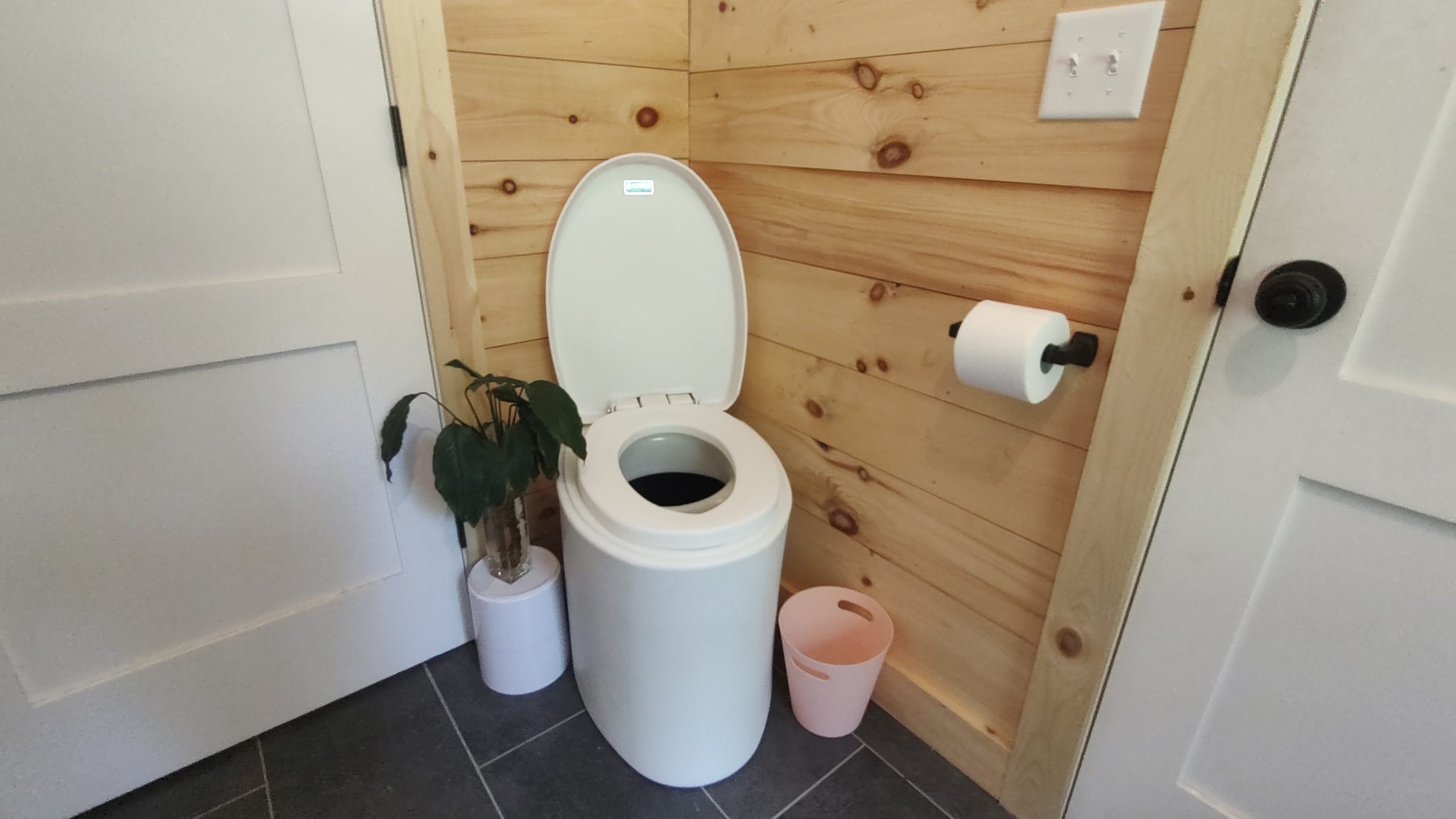
After years of traveling the U.S. in their DIY Skoolie with two kids, Elizabeth and her family eventually settled down on a piece of land in Vermont—and brought their love for composting toilets with them. From frozen winters and overflowing pee jugs to a thoughtfully built timber frame house with a Throne composting toilet front and center, they’ve lived the full arc of tiny, off-grid, and now rooted-but-still-sustainable living.
This is their honest take on what works, what doesn’t, and why they’re still all-in on humanure. If you want to follow their off-grid adventures make sure to check out their Instagram.
Please introduce yourself!
We traveled for 3 years in our self-built Skoolie with our two kids. Then we all started to yearn for a stationary community so we bought land in northern Vermont and settled on to our property in our bus.
We lived in it for two more years while we developed our property and built a house. Now we live full time in our timber frame home with all the regular amenities including a flushing toilet (the bank made me do it) but I felt strongly enough about composting toilets that I designed our bathroom so we still use a composting toilet for the majority of our toilet needs.

What did life look like before you moved into your off-grid tiny house?
We lived in a regular home in a regular neighborhood and worked regular 40 hour a week jobs. I always thought it would be fun to gut a school bus and build out the interior to live in it so when Adam came across the idea on his own and suggested it, I immediately agreed! Plans are just plans and they always change as your needs and desires change.
We planned to build the bus, buy land, and live there in it. But then we got excited about the idea of traveling and giving ourselves and our kids the opportunity to experience so many things and places so we quit our jobs, sold our house, and hit the road. Then, after some amazing experiences on the road, we decided our next move was to buy land, settle into a local community, and build a house.
We loved living tiny for about 2.5 years, then we were ready for some more personal space. We lived in the bus for 5 years total with the last 1.5 feeling REALLY cooped up but wouldn’t trade our time in the bus for anything. Now we are in a house that we see as a forever solution… but we are already scheming about our rig for when our kids are off in college when we can rent out the house for some multi-month travels again. So who knows what the future holds!

Tell us more about your off-grid home!
We built our Skoolie ourselves and it was on the road for 3 years. It’s still movable but right now is just serving as supplemental sleeping quarters on our property for when we have guests.
When we were traveling, our favorite part of the country was the southwest! We would set ourselves up in different locations for anywhere from a week to a month or more. But then we fell in love with Vermont after thru-hiking the Long Trail.
The Skoolie has a bathroom with a compost toilet (actually it has had three different compost toilets over the years), a shower, kitchen with a double sink, household propane range, apartment sized refrigerator, queen sized bed, kid sized bunk beds, wood burning stove, 92 gallons of freshwater, 100 gallon grey water tank.
Our house has all the standard house stuff with the addition of a compost toilet because, well, I’m just a crazy lady who got really passionate about composting!


Tell us about something you love about your space!
In both structures I have loved our wood burning stoves more than anything else. They make the space so cozy and homey. In our timber frame house I love how much wood there is everywhere. We used a lot of wood in our bus as well so I guess we just have a thing for the look of wood.
What’s something you’d want to change about your space?
In our current house, if money wasn’t a factor, we would have built more self-sufficient and off-grid features. Our original plans (before the bank got involved and shot them all down) included rainwater collection as our water source and an off-grid solar power system that would probably need to be supplemented by wind or something else in the winter.
I also wouldn’t have put in a full septic system but instead used a composting toilet and grey water filter system. But, when it’s a residential home and you are relying on the bank to give you a loan to build it, you don’t get a lot of say.

What are the biggest challenges with this type of lifestyle? What are the biggest benefits?
When we were off-grid in the bus, the biggest challenges we encountered were the winters in northern VT. We didn’t build the bus with the plan to live in such an extreme climate and pretty quickly learned that we were not going to be able to keep the pipes from freezing so we had no running water for about 5 months of the year.
We also had spent most of our winters in the southwest with abundant sunshine and when we experienced the low sun in VT that stayed hidden behind clouds most days in the winter, we realized we were unable to produce the necessary power. So our first winter we hauled water in 5 gallon jugs from a nearby spring and used these for all of our family’s water needs, took weekly showers at a local lodge that was kind enough to be open to that arrangement, turned off our refrigerator, kept all of our frozen food outside, kept our refrigerator food on the floor near the bus door where the cold drafts came in, and set alarms to wake up every 2 hours in the night to load the wood stove. I would NOT want to do that again.
We got to backpack and rock climb and LIVE in some of the most beautiful and interesting places in the country! Our kids learned so much about history and geology and science in all the places we traveled to. We got to make friends with people living in similar ways to us but with so many different histories, reasons, and goals.
Now that we are living stationary, we love the roots we are getting to put down: being part of a local community, our kids building strong friendships, volunteering at the library, skiing and working at our local mountain, growing a garden, tapping trees to make maple syrup, and in a few years eating fruit from our own trees.
Both the nomadic and stationary lifestyles have so many benefits. I’m glad to have experienced and chosen both at different times in my life.


Tell us about your toilet solution!
I mentioned that we had three different compost toilets – we chose compost toilets for the freedom and simplicity over a black tank system that required water and special dump stations. But we encountered challenges because of design flaws in our first two compost toilets.
The first required you to churn it with a crank (too difficult for kids to do) and had to be fully removed and upended to empty. Its solids tank filled about every 2 weeks (MAX) and the liquids tank overflowed multiple times and had to be emptied every 24-48 hours (family of 4).
The second toilet didn’t require any churning and the solids bucket could go a little longer between emptying and the big improvement was that you just had to lift the bucket out, not the entire toilet. The liquids, we plumbed into a large tank under the bus that we would empty at RV dump stations every couple of months.
Both of these toilets had one other major issue: cleaning. The first had inaccessible places that the liquids regularly got into. The urine scale builds up and just looks nasty (plus smells nasty). We also had the toilet paper get jammed in there (kids) that we had to pick out with tweezers. Barf!
Toilet 2 has a long narrow tube that drains the liquids to their tank. If not plumbed with a fast enough drop, we learned that scale will build up and have to be snaked from below. By far the grossest chore I’ve ever done.
Our third toilet was a Throne DIY. And while in the end, a compost toilet is always still a bucket of poo, the design of this one was clearly made by people with extensive compost toilet experience. Large openings got rid of the aiming issue and the overflow of pee into the solids bin issue. A removable bucket like with our second toilet meant that chore was still easy.
We went back to using a smaller liquids collection bin rather than plumbing into the tank since we are stationary and it’s easier just to empty the jug into my humanure pile every few days. The added capacity of 3 gallons gave us an extra day of use. The diverter was really the game changer, not just in its function but in its ease of cleaning: it’s smooth and has no nooks and crannies!
When we built our house, we got one of the Throne Premium toilets which has two major improvements over the DIY version: 1. It is all made of waterproof wipeable material without little nooks and crannies. The DIY version we made was primarily made of wood so in the event of a spill inside, it would be pretty nasty (fortunately the liquid level alarm helped us avoid this). 2. It looks nice! I put it in a regular bathroom and the smooth white finish fits well with the rest of our “normal” household bathroom fixtures.
Well, the toilets are called “composting” so I was interested in learning how I could actually compost the contents to reduce waste. There wasn’t really a way to do that living on the road. There are no places you can take your toilet contents to be composted (at least not that I found).
As we settled down onto our land I knew I would compost to reduce waste and return the nutrients to the soil from which we would grow food. I read the Humanure Handbook which I jokingly referred to as my bible. I just love the mental image I have of a nutrient cycle where the energy doesn’t flow in a line from fertilizer to food to my body to a septic tank where it dies, but instead, continues to feed microorganisms who in turn feed my soil and the food I grow in future years that provide me with food…. and so on.
I pee-cycle some of the pee into the garden but there is far too much pee to water my plants. I dilute it at least 5 parts water to one part pee so I don’t burn the plant. The rest of the pee goes into the compost pile to keep it nice and wet (good for the little organisms living in there) and put those pee nutrients in a place where they can be used rather than go to waste. I’d encourage anyone interested in trying humanure to keep trying new things until you get it right.
I’ve been doing it for about 3 years now and my first compost bin didn’t get very hot. I don’t think I added enough carbon material to get the heat up. Because of this, it was kinda gross and sludgy I had to take apart the bin, add a whole bunch of wood chips, turn it around with a pitchfork, and leave it for another year.
With the next year’s bin, I added a ton more hay. The pile was getting a little warmer but not much. I started putting wood shavings from a local sawmill and after about a week I had that pile up to 120 degrees! I’m thinking that maybe hay just doesn’t really contribute that much carbon compared to wood. Now I’ve got piles going on a 3 year cycle: year one is adding material, year 2 is sitting, year three is sitting again just to make sure it’s fully composted, and then it goes to my plants where I’m growing apple trees, blueberry bushes, and a vegetable garden.


Has your Throne solved the problems you were trying to address?
Yes, see previous question about the problems we were trying to address. If building another rig for travel, I’d absolutely go with the Throne premium unless space was a bigger concern.
In a smaller rig, I’d probably still want to use the Throne diverter because it’s really the only one i’ve used that works well. I might cut it down a little to fit a smaller space and modify the DIY build plans to make the toilet take up less space front to back but I’m pretty committed to the diverter.
Finances can be a major crux for getting into this lifestyle. Do you have any advice?
If you can build your project slowly without accumulating any debt or requiring financing from a bank, you’ll have much more freedom. We did that with our bus but were unable to wait any longer to build our house. We lost a lot in freedom by getting a loan from the bank but it’s what we decided was the best choice for us at the time. I’m still overwhelmed by all the expenses we took back on to live stationary again but I don’t regret it.
What is one question you frequently get asked about your lifestyle, and what’s your answer?
Why do you have two toilets in your bathroom? Because I feel strongly about composting and closing the nutrient cycle but the bank didn’t agree.
Do you have kids? How are they adjusting to the new space?
We have two kids. When we moved into our bus they were 5 and 8 and both took to the new lifestyle and compact space enthusiastically! They loved their tiny bunks, always being on “vacation”, playing with all the kids we met on the road, and exploring new places.
As they got older, our older daughter especially started to long for more privacy and personal space and a school community. The tiny bunks just didn’t feel good anymore. I also wanted the ability to have some alone time, or a space to work in quiet, and my husband needed shop space for his growing business that kept taking over the kitchen/living room in our bus.
After building the house and moving in, the kids were so excited to have their own rooms but regularly hang out in each other’s rooms or we all are together (but not squished) in our kitchen/living room with so much more space to spread out.
Leave a Reply